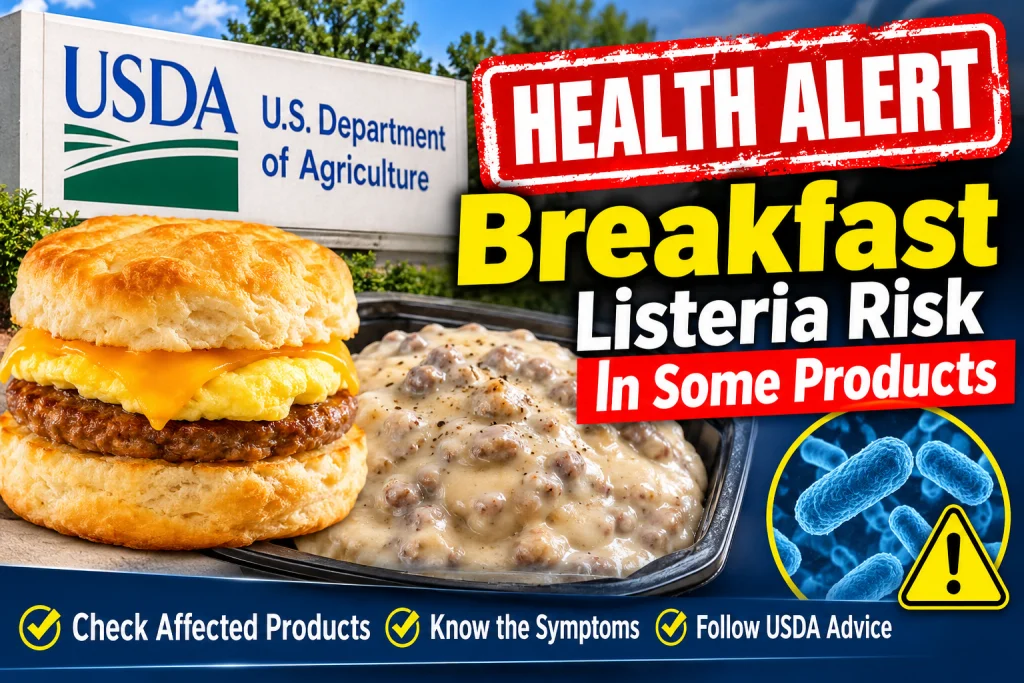
The USDA health alert involving breakfast foods is drawing attention to a potential food safety risk after federal authorities warned consumers about certain ready-to-eat breakfast products that may be contaminated with Listeria monocytogenes. The affected products include packaged biscuit and sausage gravy meals and sausage, egg and cheese biscuit sandwiches distributed through workplace cafeterias, refrigerated vending machines and grab-and-go outlets.
The U.S. Department of Agriculture’s Food Safety and Inspection Service (USDA FSIS) issued a public health alert on November 14, 2026. The warning followed concerns involving biscuit ingredients that had been recalled because of possible Listeria contamination. Fresh & Ready Foods LLC subsequently expanded its product recall, adding additional breakfast items to the list.
The announcement is important for consumers who regularly purchase convenient breakfast meals. Although no illnesses had been reported in the November 18 recall announcement, Listeria can cause serious infections, particularly among pregnant women, older adults, newborn babies, and people with weakened immune systems.
Here are seven important facts about the USDA health alert, the affected breakfast products, possible symptoms, and the steps consumers should take to protect themselves.
1. Why Did the USDA Issue a Health Alert About Breakfast Foods?
The USDA health alert was issued because certain ready-to-eat meat products contained biscuit ingredients connected to a separate supplier recall involving possible Listeria contamination.
According to the Food Safety and Inspection Service, Fresh & Ready Foods LLC received biscuits that had been recalled by C.H. Guenther & Son. The affected biscuits were used as ingredients in specific finished breakfast products.
This created a potential food safety concern because contaminated ingredients can affect other foods manufactured using those ingredients.
The USDA issued its public health alert on November 14, 2026, to notify consumers about the affected ready-to-eat products. Officials also indicated that additional downstream products could potentially be identified as the ingredient recall investigation progressed.
The situation highlights why food manufacturers must monitor their suppliers and why federal agencies issue warnings when potentially contaminated ingredients enter the food supply.
Consumers should understand that a public health alert is not necessarily the same as a formal USDA recall. However, both types of announcements should be taken seriously.
2. Which Breakfast Products Are Included in the Warning?
Two important product categories appear in the expanded Fresh & Ready Foods recall information.
Consumers should carefully compare their packaging with the official product descriptions.
Mmm! Meals Made in Minutes Biscuit & Sausage Gravy
The USDA public health alert identifies a 9.5-ounce package of Mmm! Meals Made in Minutes Biscuit & Sausage Gravy.
Important product identification details include:
- Brand: Mmm! Meals Made in Minutes
- Product: Biscuit & Sausage Gravy
- Package size: 9.5 ounces
- SKU: 90013
- Establishment number: EST. 51248
- Use-by dates: November 12 through November 18, 2026
- Packaging: Clear plastic clamshell container
The affected products were distributed in Arkansas, Louisiana, Mississippi, Oklahoma, Tennessee, and Texas.
Fresh To You Sausage, Egg & Cheese Biscuit Sandwich
The expanded company recall also identifies a 5.7-ounce Fresh To You Sausage, Egg & Cheese Biscuit Sandwich.
Its identifying information includes:
- Brand: Fresh To You
- Product: Sausage, Egg & Cheese Biscuit Sandwich
- Package size: 5.7 ounces
- SKU: 3100048
- Fresh-through dates: November 12 through November 22, 2026
- Packaging: Clear plastic film
These products were distributed in Alabama, Arkansas, Louisiana, Mississippi, Oklahoma, Tennessee, and Texas.
The products were distributed between October 15 and November 11, 2026, through workplace break rooms, grab-and-go coolers, refrigerated vending machines, and micro-markets.
Important: The USDA alert specifically concerns the biscuit and sausage gravy product. The expanded sausage, egg, and cheese sandwich recall was announced through the FDA’s recall system. Both announcements are connected to the same supplier biscuit contamination concern.
3. What Is Listeria and Why Is It Dangerous?
Listeria monocytogenes is a bacterium that can cause a foodborne infection known as listeriosis.
The bacteria can contaminate different types of food and create serious health concerns. One important characteristic of Listeria is its ability to grow at refrigeration temperatures.
This means that keeping a potentially contaminated product refrigerated does not guarantee that it is safe to eat.
Listeriosis can cause symptoms ranging from mild digestive problems to severe illness. Some infected individuals may experience fever, muscle aches, headache, nausea, and diarrhea.
In more serious cases, the infection can spread beyond the digestive system and affect the bloodstream or nervous system.
Possible symptoms include:
- Fever and muscle pain
- Severe headache
- Stiff neck
- Confusion
- Loss of balance
- Nausea and diarrhea
- Abdominal discomfort
Symptoms may take time to develop after exposure. Anyone concerned about consuming an affected product should contact a healthcare professional for advice.
The USDA health alert is therefore important even for consumers who feel healthy immediately after eating a potentially contaminated meal.
4. Who Is Most at Risk From Listeria Infection?
Although Listeria can affect anyone, some people have a greater risk of developing serious complications.
Pregnant Women
Pregnant women are among the groups most vulnerable to serious consequences from listeriosis. An infection during pregnancy can lead to miscarriage, stillbirth, premature delivery, or severe infection in a newborn.
Older Adults
People aged 65 and older may face a higher risk of serious illness because immune system function can become weaker with age.
Newborn Babies
Newborns can develop severe infections if Listeria is transmitted during pregnancy or childbirth. Early medical attention is important when an infection is suspected.
People With Weakened Immune Systems
Individuals with weakened immune systems may be more vulnerable to invasive Listeria infections. Certain medical conditions and treatments can increase this risk.
People in these groups should pay particular attention to food recall announcements and avoid products identified in official safety warnings.
5. What Should Consumers Do if They Purchased the Affected Breakfast Products?
Consumers who purchased the identified products should take precautions immediately.
The most important step is to avoid eating any product that matches the affected identification information.
Here are practical steps to follow:
- Check the package: Compare the brand, product name, size, SKU, and use-by or fresh-through dates with the official recall announcement.
- Do not eat affected products: Do not taste the food to determine whether it is contaminated.
- Discard the product: Follow the company’s instructions to throw it away or return it to the place of purchase.
- Check refrigerators and freezers: Look for affected packages that may have been stored for later consumption.
- Clean food-contact surfaces: Clean and sanitize areas, containers, and utensils that may have contacted the affected food.
- Wash your hands: Wash your hands thoroughly after handling recalled packaging.
- Contact a healthcare professional: Seek medical advice if you are concerned about possible exposure or develop symptoms.
Reheating a recalled product should not be treated as a substitute for following the official recall instructions.
Food businesses, vending machine operators and workplace cafeteria managers should also check their inventory and remove affected products from circulation.
6. Where Were the Affected Breakfast Products Distributed?
The expanded Fresh & Ready Foods recall identifies several states where the affected breakfast products were distributed.
These include:
- Alabama
- Arkansas
- Louisiana
- Mississippi
- Oklahoma
- Tennessee
- Texas
The distribution channels are particularly important because these products were not necessarily sold through traditional grocery stores.
Instead, many were distributed through workplace break rooms, refrigerated vending machines, cafeterias, micro-markets, and grab-and-go coolers.
This means consumers who regularly purchase breakfast sandwiches at work should also check the recall information.
A person may not recognize a recalled product if it was purchased from a vending machine rather than a supermarket.
Businesses should check product labels and inventory records carefully to ensure that affected items are no longer available to customers.
7. Have Any Listeria-Related Illnesses Been Reported?
According to the November 18, 2026, FDA recall announcement, no illnesses had been reported in connection with the expanded recall at the time of publication.
This is an important detail, but it does not mean that the affected products are safe to consume.
Foodborne infections can take time to develop, and people may not immediately connect their symptoms with something they ate previously.
Consumers should continue to follow official food safety instructions even when there are no confirmed illnesses.
Anyone who believes they may have consumed a potentially contaminated product should contact a healthcare professional, particularly if they are pregnant, older, or immunocompromised.
People experiencing serious symptoms should seek prompt medical attention.
How to Contact USDA and Fresh & Ready Foods
Consumers who have questions about the affected products can use the contact information provided in the official announcements.
Fresh & Ready Foods LLC
- Phone: 1-855-424-8390
- Email: RecallConcern@HotLineGlobal.com
- Customer service hours: Monday through Friday, 8:00 a.m. to 6:00 p.m. Eastern Time.
USDA Meat and Poultry Hotline
- Phone: 1-888-674-6854
- Email: MPHotline@usda.gov
Consumers should also consult the official USDA FSIS and FDA websites for updated product information.
Why This USDA Health Alert Matters to Breakfast Consumers
Breakfast is an important part of many people’s daily routines. Packaged sandwiches, biscuit meals, and refrigerated ready-to-eat foods offer convenience for workers, students, and families with busy schedules.
However, this incident demonstrates how a problem involving one ingredient can affect multiple finished products.
Manufacturers depend on suppliers for ingredients, and contamination at one point in the supply chain can create risks for other companies using those ingredients.
That is why product traceability, accurate labeling, supplier monitoring, and timely public warnings are essential parts of food safety.
Consumers can also play an important role by checking recall announcements, reading product labels, and following food storage instructions.
The USDA health alert serves as a reminder that convenient food products should never be assumed safe simply because they are packaged, refrigerated, or ready to eat.
Final Thoughts
The USDA health alert about Listeria risk in breakfast foods is an important food safety development for consumers across several U.S. states.
The warning identifies Mmm! Meals Made in Minutes Biscuit & Sausage Gravy, while the expanded Fresh & Ready Foods recall also includes Fresh To You Sausage, Egg & Cheese Biscuit Sandwiches.
Consumers should check the product information carefully, avoid eating affected items, and follow official disposal or return instructions.
Although no illnesses have been reported in the November 18 announcement, Listeria can cause serious health complications, especially among pregnant women, newborns, older adults, and people with weakened immune systems.
For the latest developments, consumers should follow announcements from the USDA Food Safety and Inspection Service and the U.S. Food and Drug Administration.
The News View will continue following food safety developments and sharing important updates to help readers stay informed.
Disclaimer: This article is for general news and public awareness. It is not a substitute for medical advice. Always consult official recall announcements and qualified healthcare professionals for specific guidance.