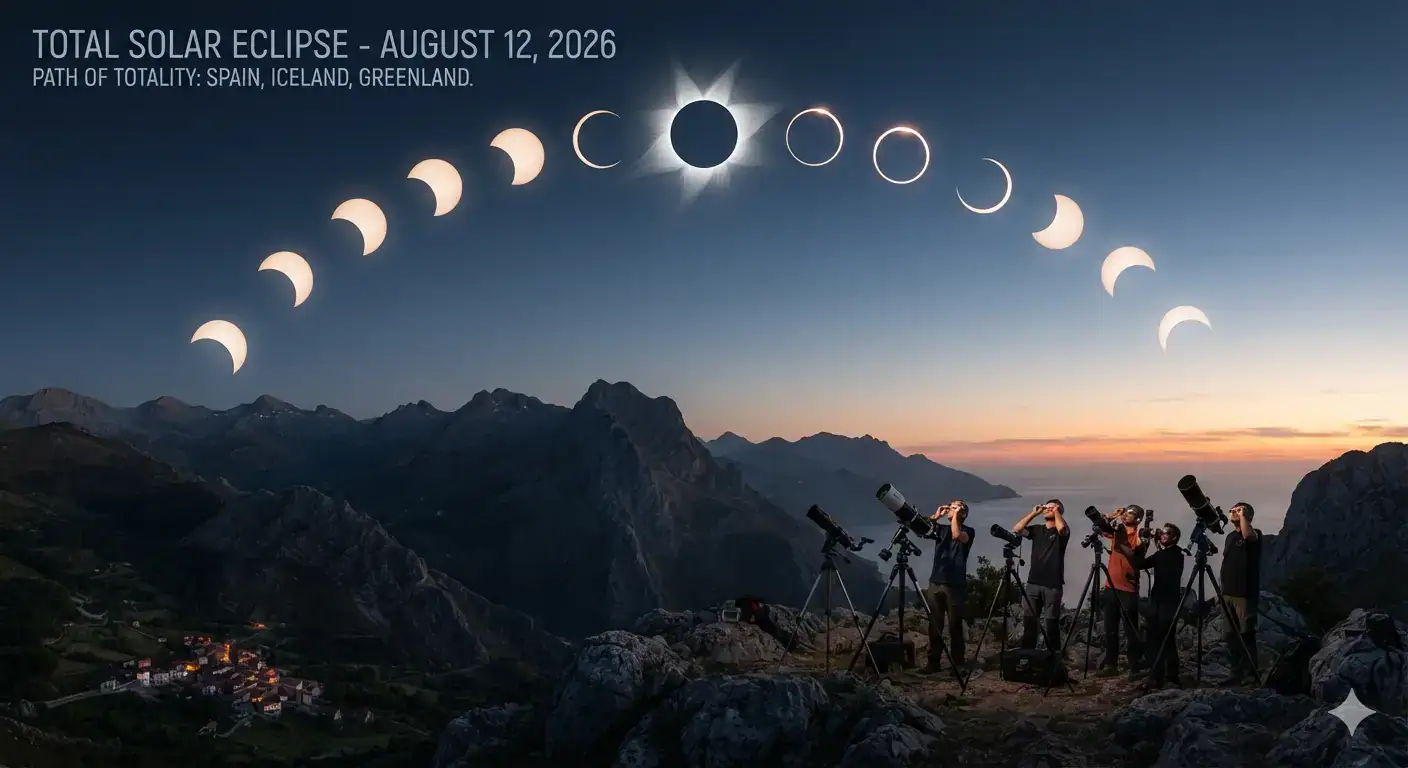
The eclipse season in August 2026 is set to be one of the most interesting periods of the year for skywatchers, astronomy enthusiasts, photographers, and anyone fascinated by the night sky. August 2026 features two major eclipse events: a spectacular total solar eclipse on August 12 and a partial lunar eclipse on August 28. Together, these events offer people around the world two very different opportunities to observe the movements of the Sun, Moon, and Earth.
The upcoming Eclipse in August 2026 presents a unique opportunity for both enthusiasts and professionals to observe solar and lunar phenomena. This comprehensive guide will detail the intricate mechanics of these eclipses, including their timings and visibility across various regions. Whether you are a seasoned astronomer or a casual observer, understanding the Eclipse in August 2026 will enhance your experience and appreciation of this sky event. Prepare to witness a remarkable display of nature’s wonders.
According to NASA, the total solar eclipse on August 12, 2026, will cross Greenland, Iceland, northern Russia, the Atlantic Ocean, Spain, and a small part of Portugal. A partial solar eclipse will also be visible across much larger areas of the Northern Hemisphere.
The second major event of the month will be a partial lunar eclipse on August 28. NASA’s eclipse calculations list August 28 as the date of the partial lunar eclipse, making August an especially exciting month for astronomical observation.
What Is the Eclipse August 2026 Event?
When people search for the eclipse in August 2026, they may be referring to either of the two eclipses occurring during the month. The first is a total solar eclipse, while the second is a partial lunar eclipse.
A solar eclipse occurs when the Moon moves between Earth and the Sun and blocks some or all of the Sun’s light from reaching parts of Earth. During a total solar eclipse, the Moon completely covers the visible disk of the Sun for observers located within the path of totality.
A lunar eclipse happens when Earth moves between the Sun and the Moon, causing Earth’s shadow to fall across the lunar surface. During a partial lunar eclipse, only part of the Moon enters the darkest portion of Earth’s shadow.
The two August events demonstrate these two different celestial alignments and provide an excellent opportunity to understand how the Earth-Moon-Sun system works.
August 12, 2026: Total Solar Eclipse
The biggest eclipse event in August 2026 will occur on August 12, when a total solar eclipse crosses parts of the Northern Hemisphere.
NASA identifies Greenland, Iceland, northern Russia, the Atlantic Ocean, Spain, and a small corner of Portugal as locations along the path where totality will occur. Parts of Europe, Africa, Canada, and the United States will experience a partial eclipse instead.
A total solar eclipse is particularly impressive because the Moon completely covers the Sun’s bright surface. For a short period, observers positioned in the path of totality can see the solar corona, the Sun’s extremely hot outer atmosphere.
NASA explains that the Moon’s shadow reaching Earth’s surface is relatively narrow. The darkest central shadow, known as the umbra, creates the region where totality can be experienced. Outside that area, observers may see only a partial solar eclipse.
Where Will the August 12 Solar Eclipse Be Visible?
The path of totality will stretch across several geographically diverse areas. Greenland and Iceland will be among the notable locations for totality, followed by parts of northern Russia and southwestern Europe.
Spain is expected to be an especially significant destination because portions of the country will fall within the path of totality. A small part of Portugal will also experience totality.
Beyond the path of totality, many locations will see a partial solar eclipse. NASA lists parts of the United States, most of Canada, much of Europe, and northwestern Africa among the regions that can experience a partial eclipse.
This makes the August 12 eclipse accessible to a much larger audience than the relatively narrow path of totality might suggest.
Why Is a Total Solar Eclipse So Special?
A total solar eclipse is more than simply the Moon passing in front of the Sun. It is a rare alignment involving three celestial bodies.
The Moon must be positioned precisely between Earth and the Sun. Although the Sun is vastly larger than the Moon, the Moon can appear approximately the same size in Earth’s sky because it is much closer to us.
During totality, the bright solar disk disappears, and the corona becomes visible. The surrounding sky can become noticeably darker, temperatures may change, and the landscape can take on an unusual appearance.
For photographers, scientists, and casual observers, these few minutes can provide an unforgettable astronomical experience.
August 28, 2026: Partial Lunar Eclipse
The second major eclipse in August 2026 will occur on August 28 and will be a partial lunar eclipse.
NASA’s 2026 eclipse catalog identifies the eclipse in August 2026 as a partial lunar eclipse.
Unlike a solar eclipse, a lunar eclipse does not require special eye protection. The Moon is reflecting sunlight rather than producing intense light itself, so it can be viewed directly.
During a partial lunar eclipse, Earth’s shadow gradually moves across the Moon. Part of the lunar surface becomes darker while another part remains illuminated by direct sunlight.
Depending on the observer’s location and local conditions, the eclipse can provide a striking view of Earth’s curved shadow crossing the lunar disk.
How Long Does the August 28 Lunar Eclipse Last?
The exact viewing times depend on location and time zone. For example, astronomical calculations for locations where the eclipse is visible show the event beginning with the penumbral phase, followed by the partial phase, before eventually ending.
One location-specific calculation lists the eclipse beginning at 9:23 p.m. on August 27, reaching maximum at 12:12 a.m. on August 28, and ending at 3:01 a.m. local time. The exact local experience differs according to geographic position.
This is why anyone planning to photograph or observe the eclipse in August 2026 lunar eclipse should check an eclipse timetable specifically for their location.
Solar Eclipse vs. Lunar Eclipse
The two August 2026 eclipses are very different.
The August 12 event is a total solar eclipse, meaning the Moon blocks the Sun for observers in the path of totality.
The August 28 event is a partial lunar eclipse, meaning Earth’s shadow covers only part of the Moon.
Another major difference is safety. Looking directly at the Sun during a partial or total solar eclipse before and after totality can cause serious eye injury. Proper solar viewing equipment is essential.
The Moon, however, can be safely viewed without special eclipse glasses.
How to Watch the August 12 Solar Eclipse Safely
Anyone planning to observe the August 12 solar eclipse should make eye safety a priority.
Ordinary sunglasses are not sufficient for viewing the Sun. Specialized solar-viewing glasses or appropriate solar filters designed for direct solar observation should be used.
During a total solar eclipse, there is a brief period of totality when the bright solar disk is completely covered. However, viewers must know exactly when totality begins and ends. Once sunlight starts returning, proper eye protection is required again.
NASA also plans to provide coverage of the August 12 eclipse, giving people outside the viewing path another way to follow the event.
Best Places to Experience the August 2026 Solar Eclipse
For travelers hoping to experience totality, locations inside the eclipse path are the most important consideration.
Greenland and Iceland are notable destinations along the entire path. Spain is another major location, while parts of Portugal and northern Russia also fall within the path.
Choosing a location involves more than simply being inside the path. Weather conditions, cloud cover, transportation, accommodation, local visibility, and the position of the Sun in the sky can all affect the experience.
For photographers, an unobstructed horizon can also be important.
Because eclipse travel can become popular, anyone planning a dedicated trip should organize transportation and accommodation well in advance.
Can the August 2026 eclipse be seen from everywhere?
No. A total solar eclipse is visible only from a relatively narrow path on Earth’s surface.
However, a partial solar eclipse can be visible across a much broader region. NASA states that portions of the United States, Canada, Europe, and northwestern Africa will have opportunities to see the Sun partially eclipsed on August 12.
The August 28 lunar eclipse has a different visibility pattern. Lunar eclipses can potentially be seen from a much larger portion of Earth’s night side because the Moon is visible across a broad geographic area.
Whether a particular person can observe either eclipse depends on their location, local daylight or nighttime conditions, and weather.
Tips for Eclipse Photography
The eclipse in August 2026 will provide exciting photography opportunities.
For the solar eclipse, photographers should use equipment specifically designed for safe solar photography. A normal camera lens pointed toward the Sun without an appropriate solar filter can be damaged, and the intense sunlight can create serious risks.
A sturdy tripod can help produce sharper images. A telephoto lens can make the eclipsed Sun appear larger in the frame, while a wider lens can capture the eclipse together with the surrounding landscape.
For the lunar eclipse, photography is considerably simpler. A camera mounted on a tripod can capture the changing appearance of the Moon as Earth’s shadow moves across it.
Photographers should experiment with exposure settings because the Moon’s brightness changes dramatically during the different phases.
Why Eclipses Matter to Science
Eclipses are not merely beautiful astronomical events. They also provide opportunities for scientific research.
Total solar eclipses allow researchers to study the solar corona, which is normally difficult to observe because the bright solar disk overwhelms it.
The corona contains extremely hot plasma and is closely associated with solar activity and the Sun’s magnetic environment.
Eclipses also provide educational opportunities. They help students and the general public understand orbital mechanics, shadows, planetary motion, and the scale of the solar system.
The August 2026 eclipse therefore has both scientific and educational importance.
Eclipse August 2026 and Astronomy Education
Teachers can use the August events to introduce students to fundamental astronomy concepts.
Students can investigate why solar eclipses happen, why lunar eclipses are less geographically restricted, and why eclipses do not occur every month.
They can also create eclipse models using a lamp, a ball, and a smaller object to represent the Sun, Earth, and Moon.
The August 12 total solar eclipse and August 28 partial lunar eclipse provide an excellent real-world example of how orbital alignment produces dramatic changes in what people see in the sky.
What Makes August 2026 Unique?
One of the most interesting aspects of the eclipse in August 2026 is that the month contains both a total solar eclipse and a partial lunar eclipse.
NASA’s 2026 eclipse list includes four eclipses during the year: an annular solar eclipse on February 17, a total lunar eclipse on March 3, a total solar eclipse on August 12, and a partial lunar eclipse on August 28.
The two August events occur only a little over two weeks apart, making the month particularly attractive for astronomy enthusiasts.
Final Thoughts on Eclipse August 2026
The eclipse and August 2026 events promise an exciting month for anyone interested in astronomy and the night sky.
The August 12 total solar eclipse will be the headline event, with totality crossing Greenland, Iceland, northern Russia, the Atlantic, Spain, and a small portion of Portugal. Many other parts of the Northern Hemisphere will experience a partial solar eclipse.
Then, on August 28, observers in suitable regions can look forward to a partial lunar eclipse as Earth’s shadow passes across part of the Moon.
Whether you are an experienced astronomer, a photographer, a student, or simply someone who enjoys watching the sky, August 2026 offers two excellent opportunities to witness the mechanics of our solar system.
The key to enjoying these events is preparation. Check the exact timing for your location, monitor the weather, choose an appropriate viewing location, and use certified solar protection when observing the Sun.
With careful planning, the eclipse in August 2026 can become one of the most memorable astronomical highlights of the year.